

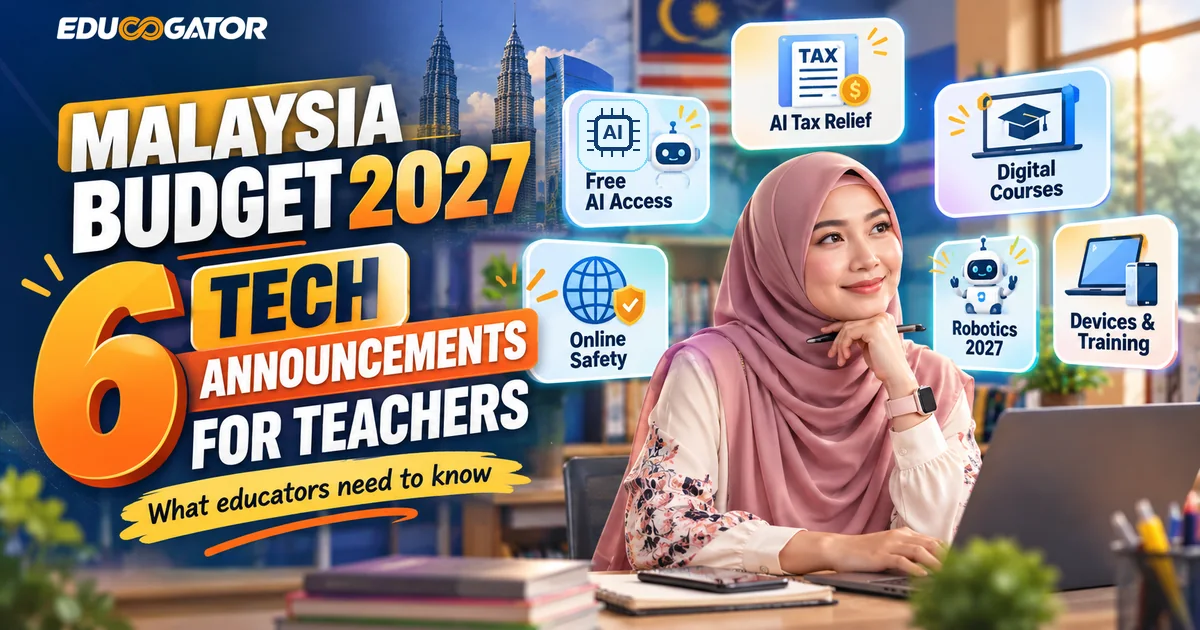
Malaysia Budget 2027 has been presented. As usual, whenever the government announces its education allocation, teachers naturally want to know what it means for schools, students and their everyday work.
Will teachers receive new computers? Is there support for AI subscriptions? What about opportunities for digital skills training?
In Malaysia Budget 2027, presented on 9 October 2026, the Ministry of Education received an allocation of nearly RM69 billion, an increase from RM66.2 billion in 2026.
However, this represents the ministry’s overall allocation, not a dedicated fund for purchasing devices or providing technology subscriptions to teachers.
What caught my attention were several announcements involving artificial intelligence (AI), digital skills, cybersecurity and robotics that could benefit the education community.
Here are six announcements I believe teachers should pay attention to.
1. An Additional 100,000 Free AI Subscriptions, Including Apps Like ChatGPT
The government announced an additional 100,000 free AI subscriptions for young people. The initiative will also expand to include AI applications such as ChatGPT.
This is interesting because access to paid AI applications could give eligible users more opportunities to explore what these tools can offer.
What does this mean for teachers?
If eligible students or young people receive access, teachers could guide them in using AI to develop project ideas, understand challenging concepts and evaluate information.
However, there is an important distinction.
The announcement targets young people. It does not confirm that every teacher or school student will receive a free ChatGPT subscription.
Age requirements, eligibility criteria, participating applications and registration procedures will depend on the official implementation announcements.
For classroom use, teachers must also consider student privacy, data security and age-appropriate access.
2. AI Subscriptions Are Now Included in the Expanded Lifestyle Tax Relief
This could be one of the most interesting announcements for teachers who pay for AI applications out of their own pockets.
The government announced an expansion of Malaysia’s lifestyle tax relief to include AI subscriptions.
Imagine subscribing to an AI application to help prepare teaching materials, create quizzes or plan classroom activities.
The announcement opens up the possibility of including eligible subscription expenses in personal income tax relief claims, subject to the applicable conditions.
However, tax relief does not mean the government will reimburse the full subscription cost.
Instead, it reduces taxable income for eligible individuals.
At the time of the budget announcement, the specific implementation details, including qualifying services and claim requirements, still needed to be clarified through official guidance from Malaysia’s Inland Revenue Board (LHDN).
My suggestion: If you use paid AI applications, keep your invoices, receipts and payment records. Avoid making any tax relief claims until the relevant requirements have been confirmed.
3. More Than 16,000 Free Digital Courses Through Rakyat Digital and Coursera
This is one of the most practical initiatives for teachers’ professional development.
Through the Rakyat Digital platform, the government is providing access to more than 16,000 courses, learning projects and Professional Certificate programmes in partnership with Coursera.
The available fields include AI, data analysis, digital technology and industry-related skills.
For teachers, this could be an opportunity to strengthen their own digital competencies before introducing new technologies into the classroom.
For example, Computer Science teachers could explore programming courses, while STEM educators could develop their knowledge of data analysis or AI fundamentals to design problem-solving activities.
However, this free access comes with certain conditions.
Learning licences are offered for a maximum of three months, require registration through MyDigital ID and are subject to licence availability.
UPDATE — 14 October 2026: The first cohort of 25,000 licences has been fully subscribed. New applicants are being placed on a waiting list. Teachers can check the latest information through the Rakyat Digital Skills Hub.
It is also important to note that Coursera certificates do not necessarily receive automatic recognition as professional development credits under Malaysia’s Ministry of Education (MOE/KPM).
Teachers should check the relevant institutional requirements before assuming that a course will count towards their professional learning records.
4. Safe Internet Campaigns to Be Strengthened Across All Schools
Educational technology is not just about using increasingly sophisticated applications.
Keeping students safe online is equally important.
Malaysia Budget 2027 states that the Malaysian Communications and Multimedia Commission (MCMC), known locally as SKMM, will intensify its Safe Internet Campaign across all schools, particularly to address cyberbullying and child exploitation.
I believe this is especially relevant in the age of generative AI and social media.
Students need more than the ability to use technology. They must also understand the consequences of sharing personal information, photographs, videos and digital content.
Teachers can use this opportunity to introduce classroom activities such as identifying scam messages, discussing digital footprints or evaluating suspicious AI-generated content.
Although further details are needed regarding the schedule and implementation of these campaigns at individual schools, digital safety education can already be incorporated into existing classroom activities.
5. Malaysia to Host the FIRA RoboWorld Cup 2027
Another interesting announcement is that Malaysia will host the FIRA RoboWorld Cup in 2027, an annual robotics competition that attracts participation from technical and vocational education and training (TVET) institutions, including polytechnics.
Hosting this international robotics competition could provide greater exposure to automation, robotics, programming and engineering technologies.
For TVET and STEM educators, as well as teachers who mentor school robotics clubs, this announcement could inspire more innovation-based learning activities.
Teachers can start with small projects using educational robots, microcontrollers or programming simulations.
Students could be challenged to design robots that solve real-world problems.
However, Malaysia’s role as host does not mean that every school or TVET institution will automatically receive robotics kits or financial assistance to participate in the competition.
Teachers and institutions interested in participating should wait for official announcements from the organisers regarding participation opportunities and requirements.
6. Digital Devices and Training for More Than 300 Pondok Schools
The government also announced a collaboration between the Department of Islamic Development Malaysia (JAKIM) and the Malaysia Digital Economy Corporation (MDEC) to provide digital devices and skills training to teachers and students at more than 300 pondok schools nationwide.
Pondok schools are traditional Islamic educational institutions in Malaysia.
Earlier this year, I was personally involved in an MDEC-organised training programme at a pondok school in the Tambun area of Perak.
Having been involved in such a programme, I see this announcement as a potential expansion of similar digital training initiatives.
This matters because access to educational technology should extend to different types of educational institutions, not just schools that already have well-established ICT facilities.
For teachers and students at participating institutions, digital skills training could create opportunities to develop multimedia learning materials, use digital platforms and improve technological literacy.
However, the direct beneficiaries of this announcement are the pondok schools participating in the programme.
It is not an announcement that all schools under Malaysia’s Ministry of Education will receive new devices.
My view: Providing devices is a good starting point, but continuous training and technical support are equally important to ensure that the technology is meaningfully integrated into teaching and learning.
What Should Teachers Do After Malaysia Budget 2027?
Of these six announcements, I see three opportunities that are particularly relevant to everyday teachers: exploring free digital training, understanding the expanded tax relief for AI subscriptions and strengthening internet safety education.
The other announcements could benefit students and specific educational institutions, depending on implementation arrangements and eligibility requirements.
Teachers do not need to rush into purchasing AI subscriptions, enrolling in every available course or starting robotics projects simply because these technologies were mentioned in the budget.
Start by identifying your actual needs and wait for clear implementation details.
Final Thoughts
Malaysia Budget 2027 shows that AI, digital skills and technological development are receiving increasing attention in the country’s national agenda.
But for teachers, the real measure of success is not the number of announcements made or how advanced the technology appears.
What matters more is how these opportunities help us teach better, reduce the digital divide and prepare students for the future.
Technology should make teachers’ work easier and enrich students’ learning experiences, not simply add another application that everyone is expected to learn!
— Cikgu Siber
Official References
- Ministry of Finance Malaysia. Budget MADANI 2027 Speech, 9 October 2026 (official Malay text).
- MyDIGITAL Corporation. Ministry of Digital Provides Access to Coursera Courses Through Rakyat Digital for 100,000 Malaysians, 8 October 2026.
- MyDIGITAL Corporation. Rakyat Digital Global Learning Pass: First Cohort of 25,000 Licences Fully Subscribed; Waiting List Now Open, 14 October 2026.
- Rakyat Digital. Coursera Terms and Conditions (official Malay text).
- Rakyat Digital. Digital Skills Hub.
- FIRA Malaysia. FIRA RoboWorld Cup Malaysia — Official Portal.